

Missouri General Election- November 3, 2026
Democracy is on the Ballot
Missouri's November 3, 2026 election carries high stakes: five ballot measures that could shape state law and priorities for decades. Decisions this far-reaching demand every eligible voter's voice. Democracy is truly on the ballot.
Learn about the proposed amendments below.
Printable Voting Guide: Amendments 3, 5, 7, 8, and Proposition A (PDF)
This is a half-page guide: print front and back, then cut in half. Share it. Email it to family and friends. Help other voters get informed.Get the full amendment information from the Missouri Secretary of State’s office: https://www.sos.mo.gov/petitions/2026ballotmeasures
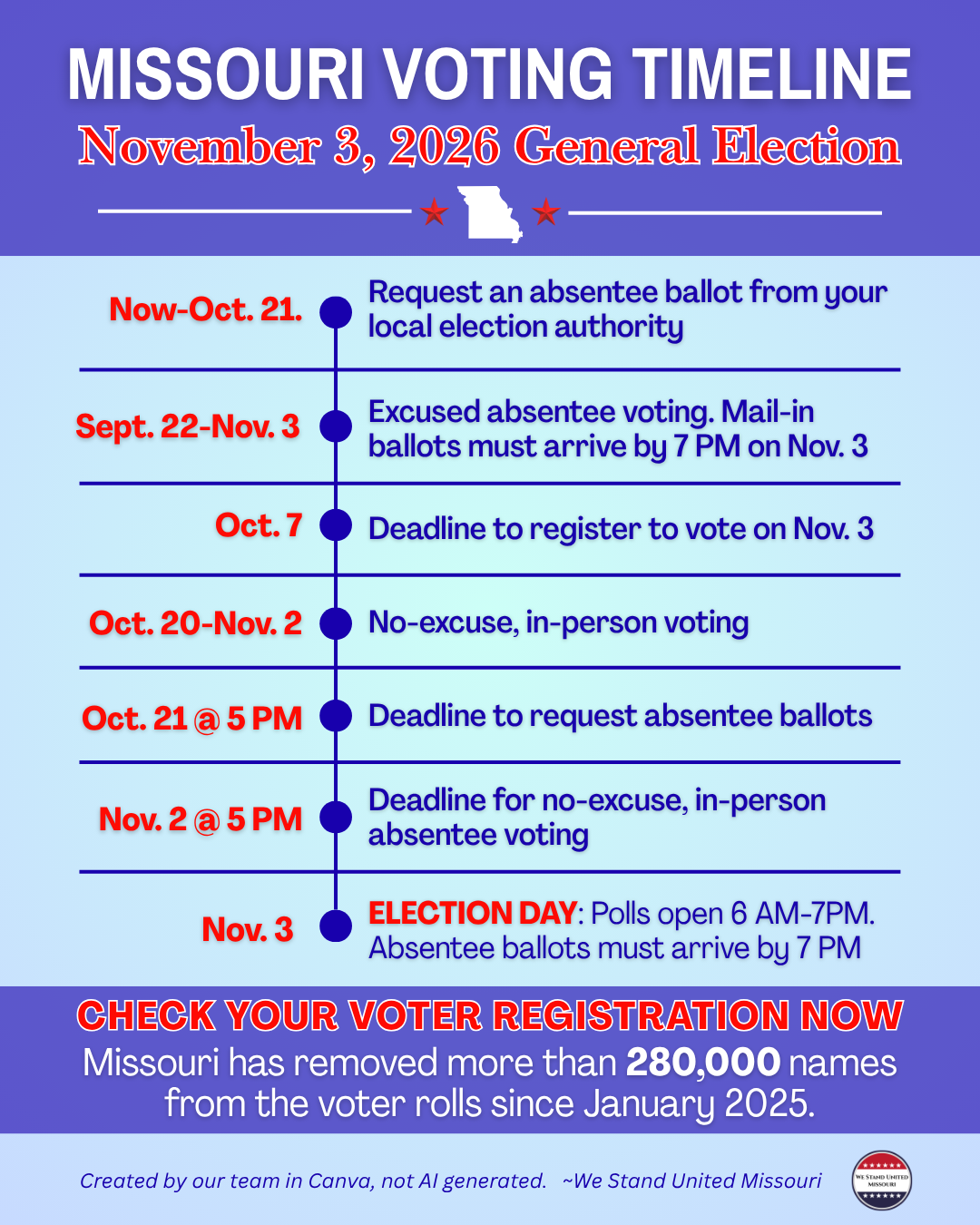
Check your voter registration. Over 220,000 voters were removed from the rolls in the past year: https://voteroutreach.sos.mo.gov/portal/
Find everything you need to vote in Missouri's November 3 election, including 1) polling locations & hours, 2) acceptable forms of identification, 3) instructions for paper and machine voting, 4) accessible voting, and 5) absentee voting here: https://www.sos.mo.gov/elections/govotemissouri/howtovote#
Sign up for weekly email updates from We Stand United Missouri on issues and events.
ISSUES ON THE NOVEMBER 3 BALLOT
These are constitutional amendments, not ordinary laws. Once passed, they are harder to change.
-
Should Missouri keep the congressional map lawmakers drew in a special session—without voters' input?
Missouri lawmakers didn't wait for the normal redistricting process. In a 2025 Second Extraordinary Session, the legislature threw out the state's 2022 congressional map—already used in two elections—and replaced it with new boundaries for all eight U.S. House seats.
YES on Proposition A would:
Block voters from overturning a gerrymandered congressional map, removing the public’s ability to check legislative overreach.
Lock in districts that dilute the voting power of hundreds of thousands of Missourians, giving some communities more influence while others lose fair representation.
Reduce fair representation by protecting a map drawn outside the normal redistricting cycle, engineered to advantage one political faction.
NO on Proposition A would:
Preserve Missourians’ right to reject an unfair, gerrymandered map.
Protect equal representation by overturning a map that weakens the voting power of hundreds of thousands of Missourians.
BOTTOM LINE: Proposition A decides whether Missouri keeps a gerrymandered congressional map or overturns it.
—————————————————————Official Ballot Title:
Do the people of the state of Missouri approve the act of the General Assembly entitled “House Bill No. 1 (2025 Second Extraordinary Session),” which repeals Missouri’s existing congressional plan, and replaces it with new congressional boundaries that keep more counties intact?
State and local governmental entities estimate no costs or savings.
Fair Ballot Language:
A “yes” vote will approve the act of the General Assembly entitled “House Bill No. 1 (2025 Extraordinary Session),” which redraws the congressional district boundaries.
A “no” vote will leave in place the congressional district boundaries enacted in 2022.
If passed, this measure will have no impact on taxes.
-
Amendment 3 would repeal the reproductive healthcare rights amendment Missouri voters approved in 2024, stripping away broad constitutional abortion access with a narrower set of exceptions and new restrictions.
It also bundles in unrelated restrictions on gender-affirming care for minors, forcing voters to accept or reject both issues as a single package.
YES on 3 would:
Repeal the reproductive healthcare rights Missourians approved in 2024.
Allow abortion for medical emergency or fetal anomaly at any stage, but for rape or incest only up to 12 weeks.
Remove constitutional protection for private medical decision-making, giving the legislature broad power to regulate abortion providers and impose new requirements.
Ban gender-affirming medical care for minors, including surgeries, hormones, and puberty blockers — even when recommended by physicians.
NO on 3 would:
Keep the 2024 reproductive-rights amendment in place, preserve abortion access through fetal viability, and prevent new constitutional bans on gender-affirming care for minors.
BOTTOM LINE: Amendment 3 would roll back the reproductive healthcare rights protections Missourians approved in 2024 and replace them with new constitutional bans.
——————————————————
Official Ballot Title:
Shall the Missouri Constitution be amended to:
Repeal the 2024 voter-approved Amendment providing reproductive healthcare rights, including abortion through fetal viability;
Allow abortions for rape and incest (under twelve-weeks’ gestation), emergencies, and fetal anomalies;
Allow legislation regulating abortion;
Ensure parental consent for minors’ abortions;
Prohibit gender transition procedures for minors?
State governmental entities estimate no costs or savings. Greene County estimates it may experience an unknown increase in tax revenue. Other local governmental entities estimate no costs or savings.
Fair Ballot Language:
A “yes” vote will repeal Article I, Section 36, of the Missouri Constitution approved by the voters in 2024 which provided reproductive healthcare rights, including abortion through fetal viability; continue to ensure women’s ability to access medical care for medical emergencies, ectopic pregnancies, and miscarriages; allow legislation to regulate abortion providers and facilities to ensure health and safety; require informed and voluntary consent for an abortion, including parental or judicial consent for minors; allow restriction of abortions to cases of medical emergency, rape and incest under twelve weeks gestation, and fetal anomalies; prohibit public funding of abortions except in limited circumstances; and prohibit gender transition procedures for minors including gender transition surgeries, cross-sex hormones or puberty-blocking drugs, with exceptions for specific medical conditions.
A “no” vote will leave Article I, Section 36, of the Missouri Constitution approved by voters in 2024 in place; will not limit abortion to cases of medical emergency, rape and incest under twelve weeks gestation, and fetal anomalies, but leave access to abortion available through fetal viability; will not prohibit gender transition procedures for minors.
If passed, this measure will not increase or decrease taxes.
Full Amendment Text: https://documents.house.mo.gov/billtracking/bills251/hlrbillspdf/2454H.05T.pdf
-
Amendment 6 would enshrine the initiative and referendum process as a fundamental right in Missouri's Constitution, protecting voters' power to make laws directly. It would bar the legislature from weakening that power—preventing lawmakers from directly overturning a voter-approved law or reviving a measure voters rejected, unless they secure an 80% supermajority in both chambers and send the change back to voters for approval. It also lets courts revise flawed ballot summary language in legal challenges rather than only striking it down, and keeps current signature thresholds and simple-majority approval rules unchanged. The fiscal statement shows no tax impact.
YES on 6 would:
Make the initiative and referendum process a fundamental constitutional right.
Allow courts to revise misleading ballot summaries.
Prohibit the legislature from weakening initiative or referendum powers.
Block lawmakers from changing or repealing voter-approved laws unless 80% of both chambers agree.
Preserve current majority vote and signature requirements for citizen petitions.
NO on 6 would:
Allow lawmakers to repeal voter-approved laws with a simple majority.
Keep rules that block courts from fixing misleading ballot summaries.
BOTTOM LINE: Amendment 6 decides whether voter-approved laws stay protected or remain easy for lawmakers to change.
——————————————————
Official Ballot Title:
Shall the Missouri Constitution be amended to:
expand the initiative and referendum petition process by making it a fundamental right;
allow courts to revise ballot summaries through lawsuits;
prohibit the legislature from weakening initiative or referendum powers;
prohibit the legislature from changing or repealing laws enacted through the initiative process, or passing laws similar to those rejected by referendum, without approval from at least 80% of both chambers; and
preserve existing majority vote and signature requirements for initiative and referendum petitions?
State and local governmental entities estimate no costs or savings.
Fair Ballot Language:
A “yes” vote will prohibit the people’s elected representatives from directly amending or changing any law enacted through the initiative process; require that any modifications to laws enacted through the initiative process be referred to the people by a vote of at least 80% of each chamber of the General Assembly; restrict the legislature from passing laws that limit the ability to pursue initiatives and referenda; maintain the current signature requirements of five percent of the individual legal voters in each of two-thirds of Missouri’s congressional districts for proposing a law; maintain the current signature requirement of eight percent of individual legal voters in each of two-thirds of Missouri’s congressional districts for proposing a constitutional amendment; and maintain the current requirement that a simple statewide majority of votes cast on a measure by individual legal voters is sufficient to enact any law or constitutional amendment.
A “no” vote will not change the current constitutional provisions, which already give citizens the right to propose initiatives and referenda.
If passed, this measure will not increase or decrease taxes.
Full Amendment Text: https://documents.house.mo.gov/billtracking/bills254/hlrbillspdf/3353H.03T.pdf
-
Amendment 7 would create the Show-Me Prosperity Fund, a permanent public endowment intended to help finance state government and, over time, potentially replace state-imposed taxes with investment earnings. The fund could grow through legislative appropriations, gifts, donations, grants, and bequests, but the amendment does not establish a dedicated revenue source or require a specific starting amount, so its size and growth timeline are not defined. The State Treasurer would manage investments under rules set by the amendment, and lawmakers generally could not draw from the fund until the Treasurer determines that earnings are sufficient to offset existing taxes—at which point withdrawals would be capped at 3% of the fund's average value over the prior five years. Taxes would remain in place unless and until that threshold is met, and if the fund later couldn't meet its obligations, the legislature could raise taxes again. The official ballot language states no immediate tax impact.
YES on 7 would:
· Requires an estimated $435 billion before taxes could be eliminated — a target experts say is financially unrealistic.
· Creates a permanent fund with no defined funding plan, leaving schools, roads, and services vulnerable while money is diverted into the endowment.
· Depends heavily on stock-market performance, exposing Missouri’s tax system and public services to market volatility and crashes.
· Lock Missouri into a risky constitutional experiment with huge management fees and no way for future legislatures to fix failures.
NO on 7 would:
· Does not create the Show-Me Prosperity Fund.
· Avoids diverting money from essential services into an undefined endowment.
Amendment 7 is a risky financial experiment with no funding plan, heavy stock market dependence, and unrealistic promises.
Official Ballot Title:
Shall the Missouri Constitution be amended to establish a permanent public endowment fund to support state government instead of taxing Missouri residents, prohibit the General Assembly from appropriating or diverting the fund, and eliminate state-imposed taxes once the fund generates sufficient revenue to replace them?
State and local governmental entities estimate no costs or savings.
Fair Ballot Language:
A “yes” vote will amend the Missouri Constitution to establish the “Show-Me Prosperity Fund,” a permanent public endowment fund to support state government with the goal of eliminating state-imposed taxes without impairing the real value of the fund’s principal; prohibit the General Assembly from appropriating or diverting monies from the fund until notification is given by the State Treasurer that the net investment earnings of the fund are sufficient to eliminate state-imposed taxes; cap the total amount of moneys that may be appropriated from the fund in a fiscal year to three percent of the average market value of the fund over the preceding five fiscal years; and prohibit the General Assembly from enacting the eliminated state-imposed taxes, provided, however, that in the event the fund is unable to meet its obligations due to insolvency, revenue shortfall, or program failure, the General Assembly shall retain full authority to appropriate funds from any lawful source and to enact legislation establishing or increasing taxes or other revenues as necessary.
A “no” vote will not amend the Missouri Constitution to establish a permanent public endowment fund to support state government with the goal of eliminating state-imposed taxes.
If passed, this measure will have no immediate impact on taxes but could lead to the elimination of state-imposed taxes if the net investment earnings of the fund become sufficient to support that outcome.
-
Amendment 8 would place a requirement in the Missouri Constitution that counties elect a sheriff every four years—a practice already generally required under current state law—along with provisions on sheriffs' duties that currently exist only in statute. It would also constitutionalize the process for removing an elected sheriff, limiting removal to a writ of quo warranto initiated by the Missouri Attorney General. That means local governments could no longer establish a different removal method through ordinary local or state legislation, and any future change to these provisions would require voters to approve another constitutional amendment, rather than a simple legislative fix. The official fiscal statement says the measure would not increase or decrease taxes.
YES on 8 would:
Add the four‑year election requirement and sheriff duties to the Missouri Constitution, making them harder to change in the future.
Allow only the Attorney General to remove a sheriff, meaning local officials couldn’t step in if a sheriff abuses their power or refuses to do their job.
NO on 8 would:
Keeps sheriff rules in regular state law, so local communities and officials can still address misconduct or remove a sheriff without needing a statewide constitutional process.
——————————————————
Official Ballot Title:
Shall the Missouri Constitution be amended to support law enforcement by preserving the right of citizens to elect a county sheriff, prohibiting the removal of a county sheriff except by a writ of quo warranto, and recognizing the office of sheriff as part of the administration of justice?
State and local governmental entities estimate no costs or savings.
Fair Ballot Language:
A “yes” vote will amend the Missouri Constitution to require counties to: elect a sheriff every four years, which is currently required by statute; place in the Constitution provisions regarding sheriffs’ duties that are currently provided by statute; and provide that an elected sheriff may be removed from office only through a writ of quo warranto initiated by the Attorney General.
A “no” vote will not amend the Missouri Constitution. Current Missouri statutes providing for the election of county sheriffs to four-year terms and governing their duties and removal will remain in effect unless changed by law.
If passed, this measure will not increase or decrease taxes.
Full ballot language: https://www.senate.mo.gov/26info/pdf-bill/tat/SJR87.pdf